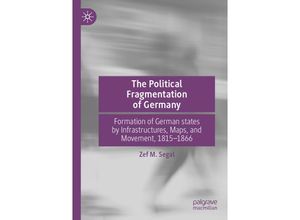
This book analyses the development of German territorial states in the nineteenth century
through the prism of five Mittelstaaten : Bavaria  Saxony  Hanover  Württemberg  and Baden. It
asks how a state becomes a place  and argues that it involves a contested and multi-faceted
process  one of slow and uneven progress. The study approaches this question from a new and
crucial angle  that of spatiality and public mobility. The issues covered range from the
geography of state apparatus  the aesthetics of German cartography and the trajectories of
public movement. Challenging the belief that territorial delimitation is primarily a matter of
policy and diplomacy  this book reveals that political territories are constructed through
daily practices and imagination.