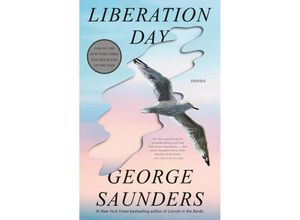
NEW YORK TIMES BESTSELLER • “One of our most inventive purveyors of the form returns with
pitch-perfect  genre-bending stories that stare into the abyss of our national character. . . .
An exquisite work from a writer whose reach is galactic.”— Oprah Daily    Booker Prize winner
George Saunders returns with his first collection of short stories since the New York Times
bestseller Tenth of December.    ONE OF THE BEST BOOKS OF THE YEAR: The New York Times Book
Review  The New Yorker  Oprah Daily  NPR  Time  USA Today  The Guardian  Esquire  Newsweek
Kirkus Reviews  Booklist  Library Journal   The “best short-story writer in English” ( Time )
is back with a masterful collection that explores ideas of power  ethics  and justice and cuts
to the very heart of what it means to live in community with our fellow humans. With his
trademark prose—wickedly funny  unsentimental  and exquisitely tuned—Saunders continues to
challenge and surprise: Here is a collection of prismatic  resonant stories that encompass joy
and despair  oppression and revolution  bizarre fantasy and brutal reality.  “Love Letter” is a
tender missive from grandfather to grandson  in the midst of a dystopian political situation in
the (not too distant  all too believable) future  that reminds us of our obligations to our
ideals  ourselves  and one another. “Ghoul” is set in a Hell-themed section of an underground
amusement park in Colorado and follows the exploits of a lonely  morally complex character
named Brian  who comes to question everything he takes for granted about his reality. In
“Mother’s Day ” two women who loved the same man come to an existential reckoning in the middle
of a hailstorm. In “Elliott Spencer ” our eighty-nine-year-old protagonist finds himself
brainwashed  his memory “scraped”—a victim of a scheme in which poor  vulnerable people are
reprogrammed and deployed as political protesters. And “My House”—in a mere seven pages—comes
to terms with the haunting nature of unfulfilled dreams and the inevitability of decay.
Together  these nine subversive  profound  and essential stories coalesce into a case for
viewing the world with the same generosity and clear-eyed attention Saunders does  even in the
most absurd of circumstances.