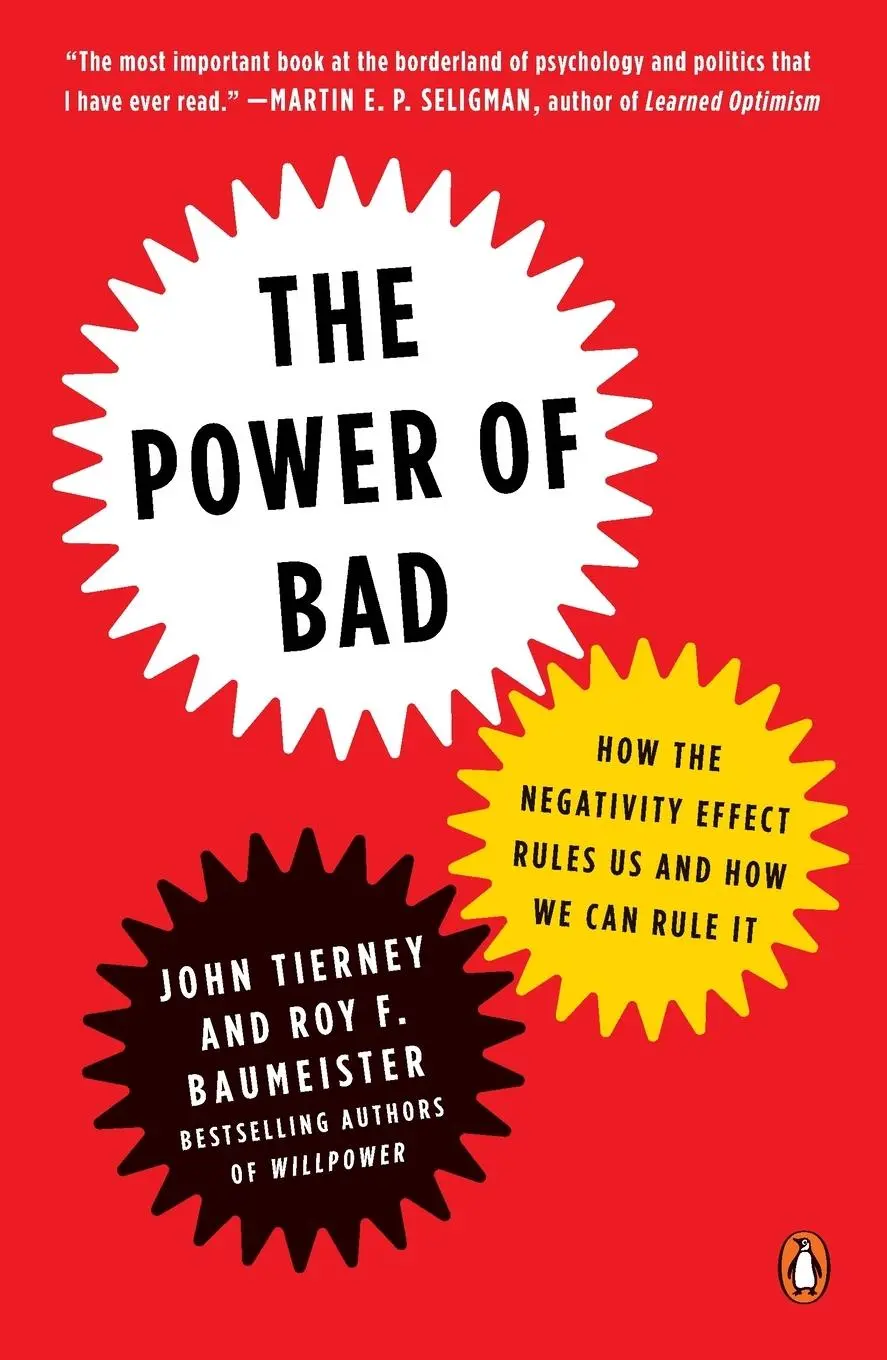
Bildquelle: preigu de
Preisverlauf (90 Tage)
Tiefstwert (90 Tage): 14,75 €
Trend
Stabile Preise
Basierend auf den letzten 14 Tagen des Preisverlaufs.
Browser-Benachrichtigung bei PreissenkungWir melden uns, sobald es günstiger wird als heute (14,75 €) — höchstens einmal am Tag. Ohne E-Mail, ohne Konto, jederzeit abbestellbar. Amazon-Angebote sind ausgenommen. Datenschutz
Hinweis: Amazon-Preise sind in der Preisverfolgung bzw. im Preisverlaufsgraphen nicht enthalten. Wir versenden keine Benachrichtigungen zu Produkten über Amazon.
Kundenbewertungen
4,0/5
(1 Bewertungen)
The Power of Bad: How the Negativity Effect Rules Us and How We Can Rule It
Hersteller:
Random House Books For Young Readers
· MPN: 7737275
Günstigster Preis
14,75 €
inkl. MwSt.
Bei 4 Anbietern im Vergleich
Zuletzt aktualisiert: 21.10.2026 10:25 Uhr
Bei averdo.com kaufen — 14,75 €
Verfügbar · inkl. MwSt. · Versand k.A.
 Finde The Power of Bad: How the Negativity Effect Rules Us and How…
Produktfakten auf einen Blick zur EAN 9780143111078
- Hersteller
- Random House Books for Young Readers
- EAN
- 9780143111078
- Hersteller-Artikelnr.
- 7737275
- Günstigster Preis
- 14,75 € (averdo.com)
- Anbieter im Vergleich
- 4 Shops
- Preise aktualisiert
- 21.10.2026 10:25 Uhr
- Gewicht
- 0.6503636729 kg
Produktbeschreibung
"The most important book at the borderland of psychology and politics that I have ever read."-Martin E. P. Seligman, Zellerbach Family Professor of Psychology at that University of Pennsylvania and author of Learned Optimism Why are we devastated by a word of criticism even when it's mixed with lavish praise? Because our brains are wired to focus on the bad. This negativity effect explains things great and small: why countries blunder into disastrous wars, why couples divorce, why people flub job interviews, how schools fail students, why football coaches stupidly punt on fourth down. All da
Preisvergleich
4 Angebote gefunden
1
averdo.com DE
Aktualisiert: 21.10.2026 10:16 Uhr
16,61 €
inkl. MwSt.
Zum Angebot
2
medimops.de DE
Aktualisiert: 21.10.2026 10:25 Uhr
14,75 €
inkl. MwSt.
Gesamt:
16,74 €
Zum Shop
3
preigu.de DE
Aktualisiert: 21.10.2026 10:20 Uhr
16,75 €
inkl. MwSt.
Zum Shop
4
buchserien.de DE
Aktualisiert: 21.10.2026 10:19 Uhr
19,00 €
inkl. MwSt.
Zum Shop
* Alle Preise inkl. MwSt., ggf. zzgl. Versandkosten. Preise und Verfügbarkeit können sich seit der letzten Aktualisierung geändert haben. Beim Klick auf „Zum Angebot" oder „Zum Shop" verlässt du EAN-Shopping.de und wirst zum jeweiligen Händler weitergeleitet. EAN-Shopping.de erhält ggf. eine Provision — für dich entstehen keine Mehrkosten. Letzte Aktualisierung: 21.10.2026 10:25 Uhr.
Weitere Produkte von Random House Books For Young Readers
Alle Produkte →

Ferguson, Niall: Kissinger: Volume 1
Random House Books For Young Readers
ab 17,05 €
inkl. MwSt.
1 Anbieter im Vergleich

Larson, Kay: Where the Heart Beats
Random House Books For Young Readers
ab 17,40 €
inkl. MwSt.
1 Anbieter im Vergleich

Green, John: John Green: The Complete Collection Box Set
Random House Books For Young Readers
ab 46,47 €
inkl. MwSt.
1 Anbieter im Vergleich

Freeman, Becca: The Christmas Orphans Club
Random House Books For Young Readers
ab 11,03 €
inkl. MwSt.
1 Anbieter im Vergleich

Ishiguro, Kazuo: An Artist of the Floating World
Random House Books For Young Readers
ab 20,57 €
inkl. MwSt.
1 Anbieter im Vergleich
Weitere Produkte in „“

Ferriss, Timothy: The 4-Hour Workweek
Harmony Books
ab 21,28 €
inkl. MwSt.
1 Anbieter im Vergleich
Stone, Douglas: Thanks for the Feedback
Random House Books For Young Readers
ab 15,98 €
inkl. MwSt.
1 Anbieter im Vergleich

Peters, Steve: The Chimp Paradox
Vermilion
ab 16,69 €
inkl. MwSt.
1 Anbieter im Vergleich

Robinson, Ken: Finding Your Element
Random House Books For Young Readers
ab 15,98 €
inkl. MwSt.
1 Anbieter im Vergleich

Sharma, Robin: The Wealth Money Can't Buy
Penguin Young Readers
ab 17,40 €
inkl. MwSt.
1 Anbieter im Vergleich
Häufige Fragen zur EAN 9780143111078
Beantwortet aus dem Preisverlauf der letzten 90 Tage, den aktuellen Händlerangeboten, den vorliegenden Bewertungen und der Nachfrage.
Ist The Power of Bad: How the Negativity Effect Rules Us and How We Can Ru… gerade günstig?
Aktuell liegt der günstigste Preis bei 14,75 €. Das ist praktisch der niedrigste Stand der letzten 90 Tage (14,75 €).
Wo ist The Power of Bad: How the Negativity Effect Rules Us and How We Can Ru… am günstigsten?
Den niedrigsten Gesamtpreis bietet averdo.com mit 16,61 € versandkostenfrei. Der niedrigste reine Artikelpreis liegt zwar bei 14,75 €, mit Versand wird dieses Angebot aber teurer.
Ist The Power of Bad: How the Negativity Effect Rules Us and How We Can Ru… lieferbar?
Alle 4 Anbieter melden den Artikel derzeit als verfügbar.
Wie stark schwankt der Preis für The Power of Bad: How the Negativity Effect Rules Us and How We Can Ru…?
In den letzten 90 Tagen bewegte sich der günstigste Preis zwischen 14,75 € und 16,26 € — eine Spanne von 10 %. Gemessen an 86 Tagen mit Preisdaten.
Lohnt sich der Preisvergleich bei The Power of Bad: How the Negativity Effect Rules Us and How We Can Ru…?
Zwischen dem günstigsten und dem teuersten der 4 Anbieter liegen 4,25 € — das sind 29 % bei identischem Artikel.
Preisdaten zuletzt aktualisiert: 21.10.2026 10:25 Uhr